Hello readers!
In this post, we’re going to be looking at how the senses can affect poetry. Hopefully most of you have read or experienced some form of poetry, whether it be simple pieces or highly complex Shakespearian works. Whether you’re new to poetry or a huge fan, these small tips can help you to create better works of writing or enhance your knowledge to find and analyze great poems!
Poetry varies depending on the stylistic quality of the writer, the tone or mood of the piece, and the length or type of poem; however, most successful poems are descriptive and allow the reader to sensually connect with the piece. There are many tools to allow the connection between reader and work, including but not limited to:
- Figurative language
- Imagery
- Sensory details
To begin, we’ll start with figurative language. Depending on your background, you may understand what it is, or be completely confused with the term. Figurative language at its simplest is different literary tools that are used by the writer to help make the work more interesting and enhance the reader’s understanding of the work. Figurative language is a broad category, and includes similes (comparing something to a different thing through words such as “like” or “as”), metaphors (like a simile but without using “like” or “as”), personification (giving something human qualities), symbolism (using an object to represent something else), hyperbole (over exaggeration) and much more! These are the most common, but there are many others, and if you want to find out more about figurative language or see more examples, yourdictionary.com is a pretty good starting point. Figurative language is also utilized to make connections to a specific object, setting, character, or mood, and can provide a better description or understanding of it within a piece.
Imagery, which fits under the umbrella of figurative language, is so broad it can be its own subpoint. Imagery is when a writer adds meaning to their work by description. Here’s an example of a sentence without a lot of imagery:
- “It was cold outside.”
The sentence describes the temperature, but it’s not easy to clearly understand or connect with it. There’s also a lot of questions that can be asked, like whether it was a cool spring, frigid winter, or chilly fall? Was it snowing or raining, or was there any wind? What’s the setting? By leaving imagery out of the sentence, the reader could have trouble understanding how to interpret the sentence. Now, here’s an example of a sentence with imagery:
- “The frigid winter air engulfed the city. Delicate snowflakes drifted from the sky, and darkened as they hit the sidewalk and smog.”
With some imagery, the sentence is more clear, and describes the setting through showing the weather and location by using description. Readers most likely will be able to understand the intentions of the sentence, and better connect with how the author wanted them to feel. Also, the sentence is more interesting to read.
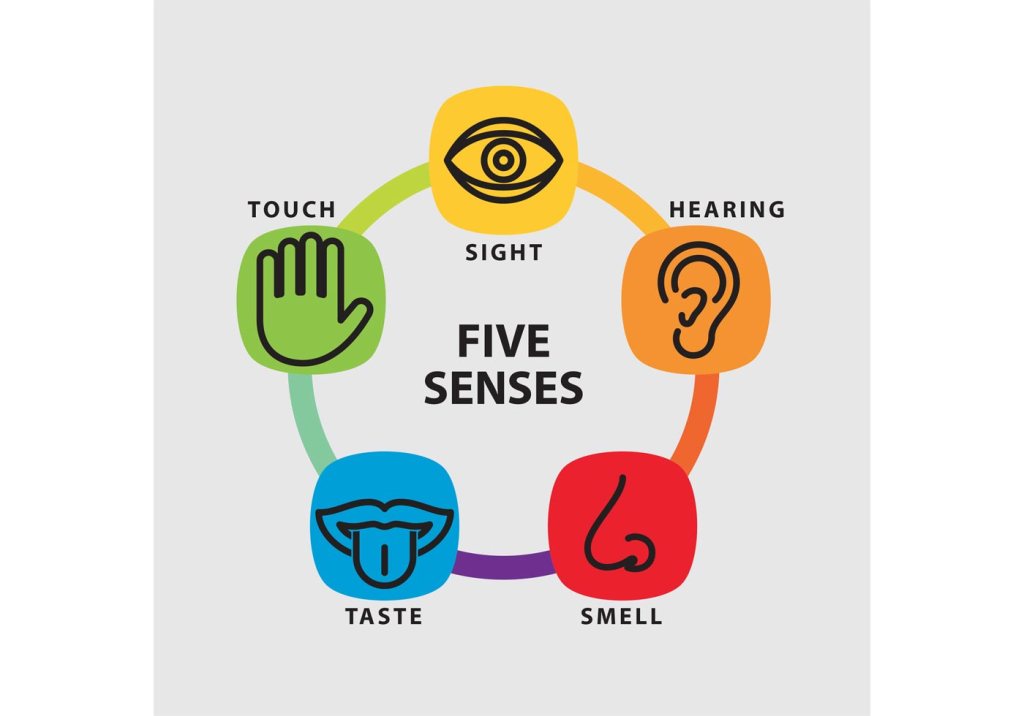
Sensory details also add to the connection between a reader and a piece of work. By describing how something feels, sounds, tastes, looks, or smells, the reader can envision themselves interacting within the work. By using strong adjectives (sparingly) or any of the devices above, a piece is bound to connect to a reader through the senses.
Hopefully this has helped to give a brief background on the different devices and tools that can be used to integrate the senses into different works to strengthen the connection with the reader. If you’re looking for poems with examples of these tools, some good starting places include “The Garden by Moonlight”(Amy Lowell), “Blizzard” (Linda Pastan), and “Song of the Son” (Jean Toomer).
Again, thanks for reading, and keep feeling those good vibes!
 Good Vibes
I really like your example of using good imagery – very strong. Also, thank you for linking a few poems at the end. I love “The Garden by Moonlight”!
LikeLike