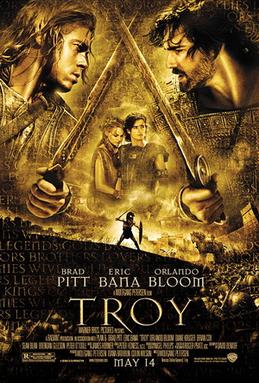
Hi readers! This post covers the movie “Troy,” and its historical relevance! Warning: it contains spoilers so if you plan on watching the movie and don’t want it to be wrecked, read this after viewing! Also, it’s written in a report format with cited sources that are listed at the bottom of the page.
The Trojan War is a very controversial topic in history, and it is debated whether or not it really occurred or if it is merely folklore. Whatever one may think, no one can dispute that the story of Troy has fascinated modern society with its tale of glory and woe; consequently, the story has been told through a modern, media-like film, Troy. The movie Troy captures the Trojan War well, but is inaccurate in some details, such as the deaths of some characters and the result of the battle.
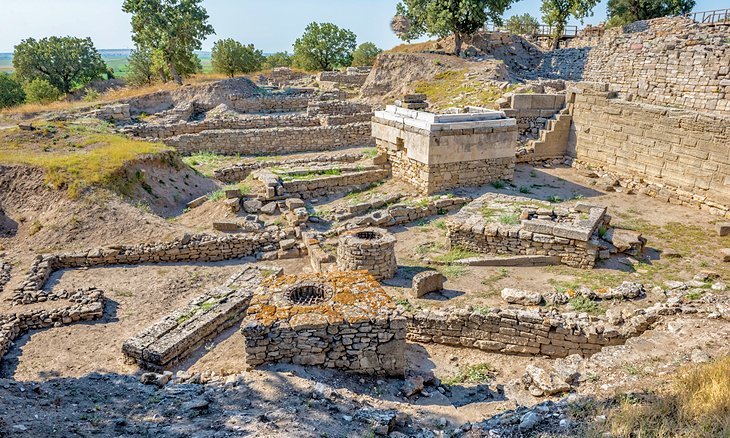
The main plot of Troy is the battle between the Trojans and the Greeks in consequence of Helen of Sparta running away with Paris, prince of Troy. Additionally, there are many strong-side plots, like the story of Achilles, which includes his love with Briseis, his conflicts with Agamemnon, and his battle against Hector. Other conflicts occur between Hector and Trojan advisors, whose unquestionable faith in the gods end up causing the downfall of Troy. The main setting of the film is on the beaches and in the city of Troy, since the Trojan War takes place there and the events that are the focus of the film are set there.
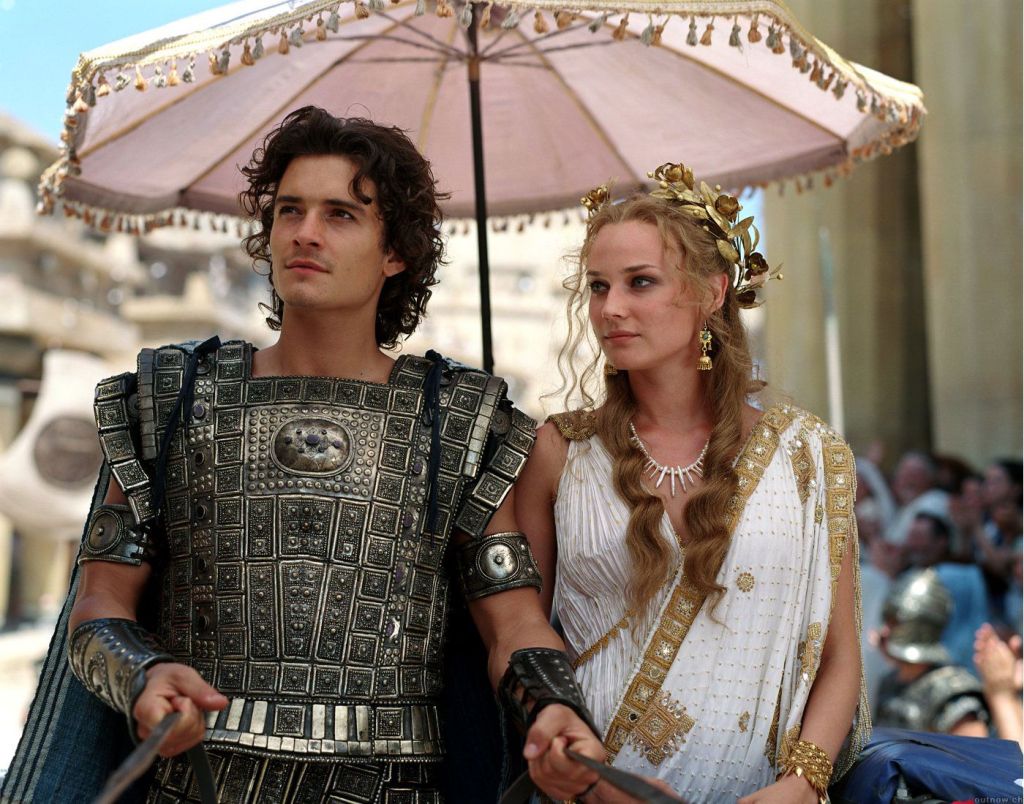
There are many characters with important roles in the film, including Paris, Helen, Hector, Achilles, and Agamemnon. Paris, a prince of Troy, begins the Trojan War when he falls in love with and runs away with Helen of Sparta, who eventually becomes Helen of Troy, in the beginning of the film. Hector, another prince of Troy, also has a major role, since he is the greatest warrior among the Trojans. He is later killed in vengeance for Patroclus by Achilles, Patroclus’s cousin, which is another conflict affecting the outcome of the battle. Furthermore, Achilles is significant since he is Greece’s greatest warrior; additionally, he is needed because a prophecy foretold that the Greeks would need Achilles if they were to win the war. Agamemnon was significant since he was leading the Greeks, and also because he had side conflicts with Achilles which may have halted or disrupted the Greeks from having more successes quicker. All of these characters are significant and vital to the film Troy, though there are some inaccuracies when depicting the characters, which is later addressed in this paper.
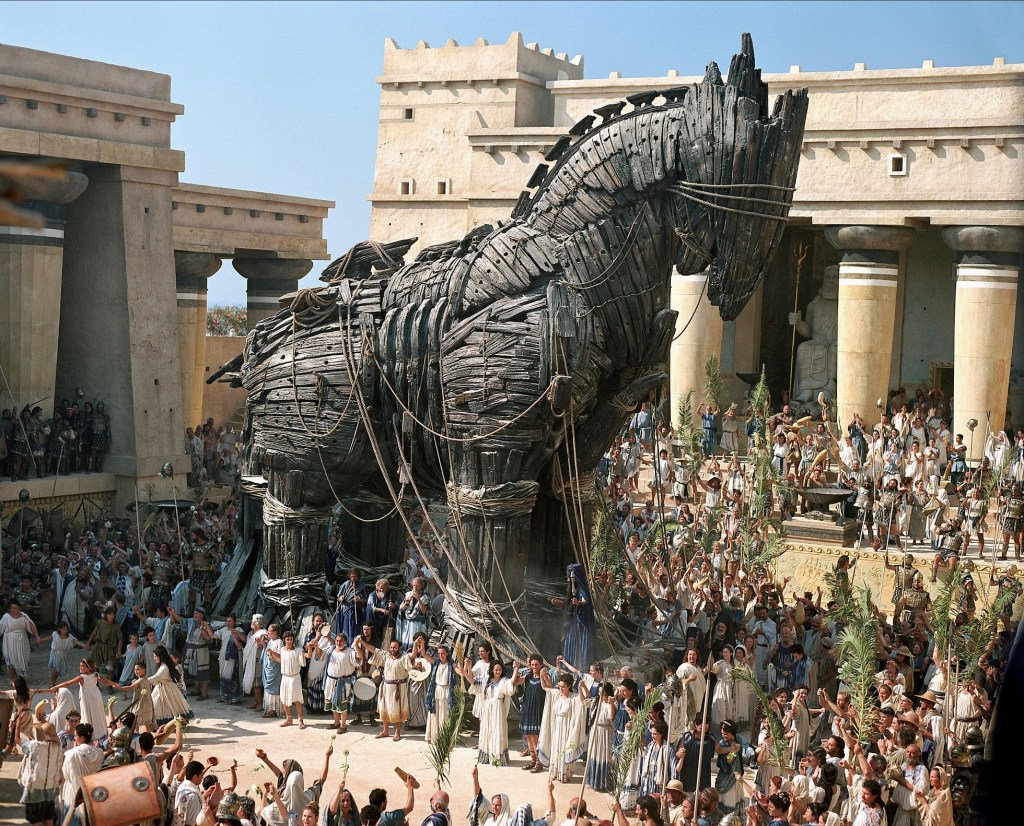
Conflicts are abundant in Troy, and can be seen in many side plots. The main conflict is the battle between the Trojans and Greeks for “Helen” and Troy, but conflicts also occur between Paris and Menelaus when they duel; Paris and Hector when deciding if Helen should stay in Troy; Hector and Achilles after Hector kills Patroclus; Hector and the Trojan advisors when they put the signs from the gods before the current situation and logical conclusions; Achilles and Agamemnon when Achilles won’t fight with the Greeks; Achilles and Paris when Paris shoots him. The climax of the film is the final battle, when the Trojan horse has entered and the Greeks are sacking Troy. This part is the climax because the most action is occurring, and all other events have led up to this point and final battle. The Trojan horse was a plan devised by Odysseus to get into the city of Troy, and involved the building of a huge wooden horse, hiding men inside, sailing the Greek fleet out of sight, and claiming it was a gift to the gods. The Trojan advisors believed this, against Paris’ concerns, and brought it into the city, where they feasted on behalf of their victory, until the men came out of the horse at night to let the other Greeks into the city, and sacked Troy while the citizens were sleeping or celebrating.
The film Troy was pieced together of some facts as well as some inaccurate events and characters. One major inaccurate event was the ending of the Trojan War. The result of the Trojan War, according to legend, ended with “The victorious Greeks kill[ing] all the men and enslav[ing] the women of the city…” (Hackney). Hackney also mentions the murder of Priam is being murdered, along with other characters such as Paris dying in the battle, and Helen being returned to the Greeks. The film, however, depicts the battle as chaos, though many Trojans escape through secret tunnels, including Helen, and Paris and Briseis are implied to have escaped as well. The deaths of Agamemnon and Menelaus are also inaccurate. In the film, Menelaus was killed by Hector when Paris was about to be killed by him in a duel, and Agamemnon was killed by Briseis. Although this was portrayed by the film, and Menelaus and Paris dueled to try to end the conflict before more men died, Aphrodite, the goddess of love, intervened by carrying Paris away as he was about to lose; Menelaus also gained Helen back at the end of the Trojan War (Dixon-Kennedy, “Menelaus”). Agamemnon also survived the Trojan War, and returned to his wife; however, she killed him after he returned and may have been assisted by her lover (Dixon-Kennedy, “Agamemnon”). Both of these deaths are inaccurately portrayed in the film, along with the endings of characters such as Paris and Helen.
Though there were many inaccurate events portrayed in the film, there were some accurate facts present. For example, the death of Achilles is accurate, since he is killed by Paris, and is shot in the only place he is vulnerable: his heel. Myth states that “Achilles was dipped bodily into the Styx by his mother Thetis, which conferred invulnerability on all but his heel” (Taylor). Greek burial rites are also portrayed accurately. The Greeks “Emphasize[d] the necessity of a proper burial and refer to the omission of burial rites as an insult to human dignity” (Department of Greek and Roman Art). This is seen in Troy when Priam begs Achilles to give back Hector’s body for the proper rites. Also, the Greeks believed that “without a proper ritual burial the shades of the dead may not cross the Styx but are forced to wait 100 years or even longer… [and] many ancient Greeks placed a coin in the mouth of the dead before burial as a very real offering,” or on the eyes of the dead (Taylor). The emphasis on proper burials along with the placing of coins on the eyes are both accurate in the film and Greek culture.
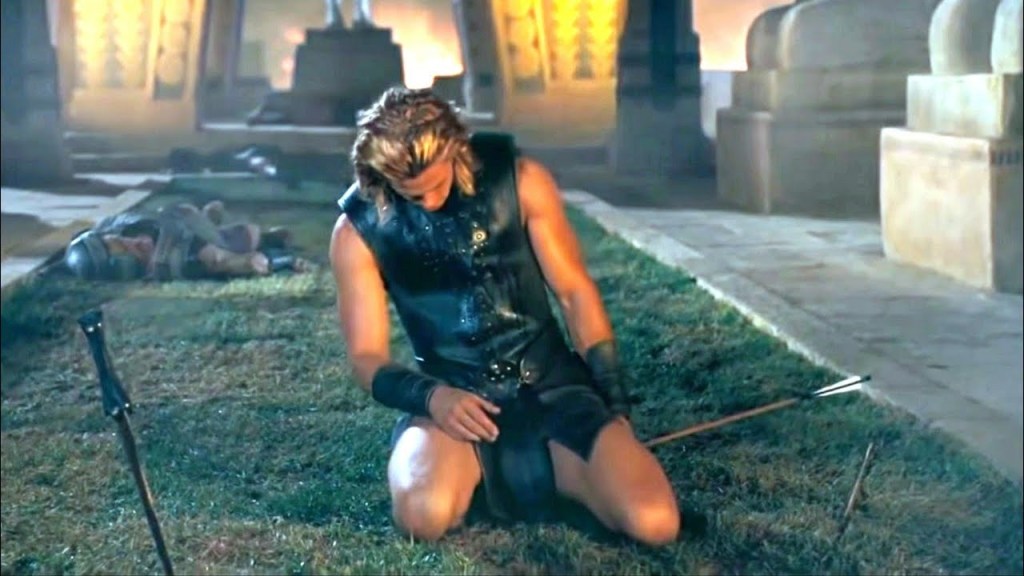
The film improves the audience’s understanding of the Trojan War, even though there are some inaccuracies. Some characters and events were altered to make the film more appealing, such as Agamemnon’s death and Helen’s escape. Since Agamemnon was a portrayed as greedy and unhonorable, viewers would be satisfied to see him die, even if a trained warrior king killed by a much weaker priestess is inaccurate. Also, the time the Trojan War lasted in Troy was portrayed as mere days, though in legend it was ten years (Hackney). For the purpose of the movie, though, shortening the war’s time was better since audience members would lose attention while watching a film that goes over ten years of war, and would not retain as much information. The overall portrayal of the war, however, was mainly based on the Iliad and legend, and Greek culture, such as burial rites, was still depicted accurately. After watching Troy, an audience would be able to take away a basic understanding of the legend surrounding the Trojan War, and the Greek culture present in the events. Besides Agamemnon, both the Trojans and the Greeks were portrayed unbiasedly and equally good, which also helps viewers understand that wars in Ancient Greece were also about fighting just to fight for honor and immortality, contrasting what wars are currently fought over; in this time period, immortality was believed to rely on the remembrance of the dead by the living, so being remembered as a great hero in a legendary battle would ensure you would be “immortal” forever, as well as achieve honor and glory for your name and family’s name (Met Museum). Overall, the film helps viewers gain insight and understanding on the Trojan War and the fascinating events and culture surrounding it.
Works Cited
Cartwright, Mark. “Trojan War.” Ancient History Encyclopedia. Ancient History Encyclopedia,
22 Mar 2018. Web. 22 Jan 2019.
Department of Greek and Roman Art. “Death, Burial, and the Afterlife in Ancient Greece.” In
Heilbrunn Timeline of Art History. New York: The Metropolitan Museum of Art, 2000–.
http://www.metmuseum.org/toah/hd/dbag/hd_dbag.htm (October 2003)
Dixon-Kennedy, Mike. “Agamemnon.” World History: Ancient and Medieval Eras,
ABC-CLIO, 2019, ancienthistory.abc-clio.com/Search/Display/575711.
Accessed 18 Jan. 2019.
Dixon-Kennedy, Mike. “Menelaus.” World History: Ancient and Medieval Eras, ABC-
CLIO, 2019, ancienthistory.abc-clio.com/Search/Display/587372. Accessed 18
Jan. 2019.
Dixon-Kennedy, Mike. “Priam.” World History: Ancient and Medieval Eras, ABC-
CLIO, 2019, ancienthistory.abc-clio.com/Search/Display/587390. Accessed 18
Jan. 2019.
Hackney, Ryan. “Trojan War.” World History: Ancient and Medieval Eras, ABC-
CLIO, 2019, ancienthistory.abc-clio.com/Search/Display/633961. Accessed 18
Jan. 2019.
Taylor, Richard P. “Styx.” World History: Ancient and Medieval Eras, ABC-CLIO,
2019, ancienthistory.abc-clio.com/Search/Display/577376. Accessed 18 Jan.
2019.
 Good Vibes